What Is Virtual Production?
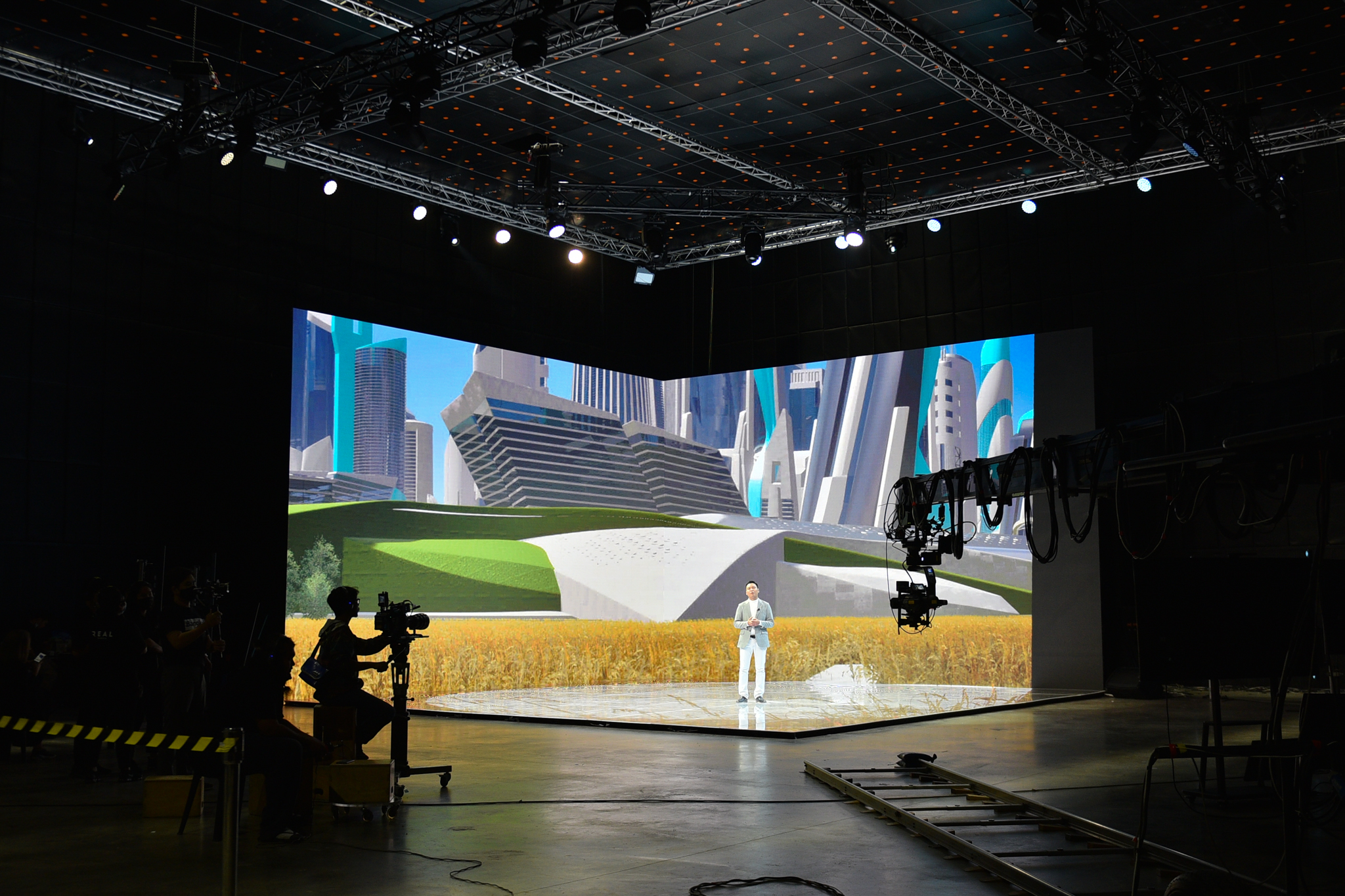
Virtual production is a filmmaking approach that replaces the traditional green screen with a large curved LED wall displaying photorealistic real-time environments. Actors perform in front of the screen, and a camera tracking system synchronises the perspective of the digital background to the physical position of the camera — creating a seamless, photorealistic composite that exists fully in-camera, without post-production compositing.
The effect is not a trick. It is a physical light source. The LED wall is literally illuminating the actors with the correct colours and intensities of the environment it is displaying. A sunset scene bathes the cast in warm amber. An interior corridor creates soft, directional light from the visible ceiling panels. This interaction between digital content and physical light is what separates virtual production from any previous attempt to blend CG environments with live-action footage.
How It Works: The Three Core Systems
Every virtual production setup is built on three interdependent systems working in precise synchronisation.
The LED Volume
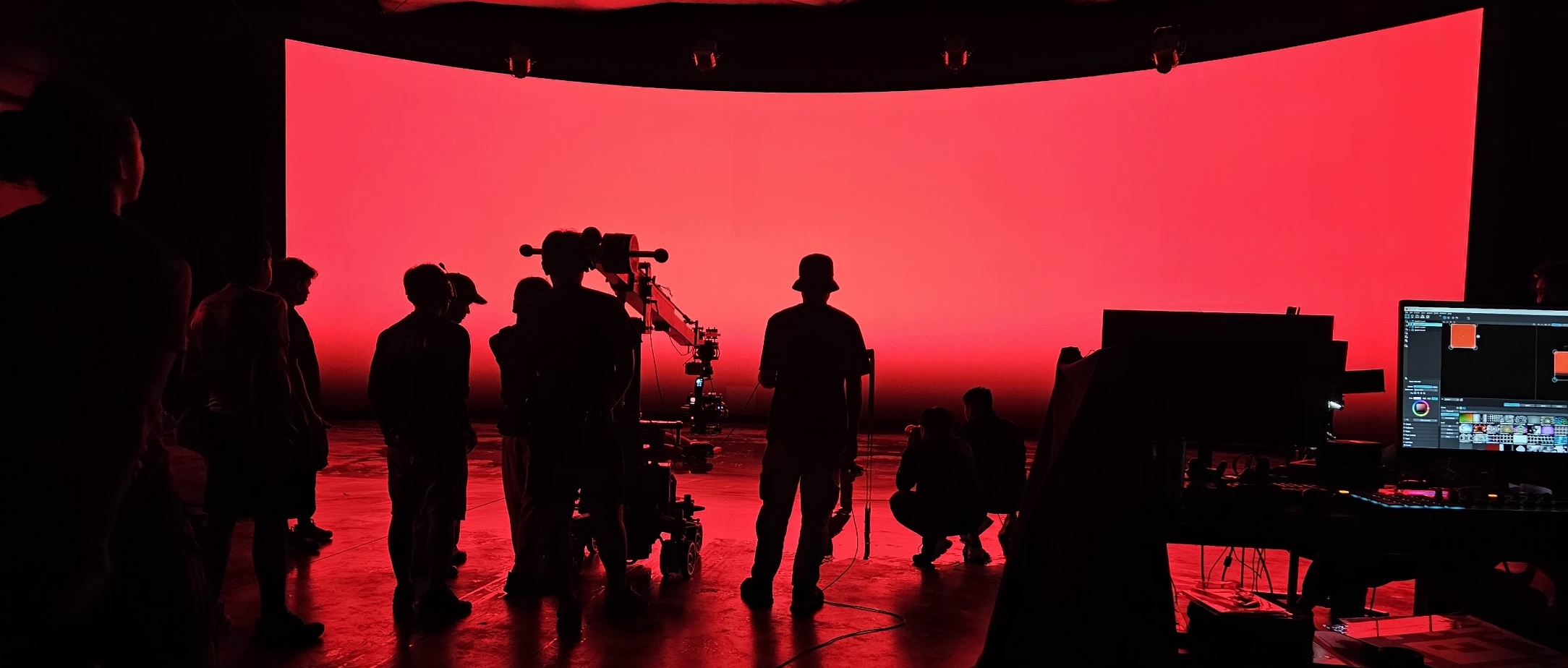
The LED volume is the physical curved screen that wraps around the set. Standard configurations use a main back wall with optional side wings and ceiling panels (the "ceiling piece" or "lid"). Volume dimensions vary from compact broadcast setups — 6 metres wide by 3 metres tall — to large film stages exceeding 20 metres in width. Panel selection is critical here: fine pitch (typically P1.9 or finer), high refresh rate (7,680Hz minimum for camera work), and calibrated colour accuracy are non-negotiable specifications.
Camera Tracking
A camera tracking system records the position and orientation of the physical camera in real time and feeds that data to the rendering engine. The engine adjusts the virtual camera perspective to match — a process called parallax compensation. Without tracking, the background is static and the illusion breaks immediately as soon as the camera moves. Systems from Mo-Sys, Stype, and others use optical, mechanical, or inertial measurement methods to deliver sub-millimetre accuracy at full broadcast framerate.
Real-Time Rendering Engine
Unreal Engine is the current industry standard for virtual production rendering. It processes the tracking data, calculates the correct perspective view, applies colour grading to match the LED wall's output characteristics, and renders the final image at the framerate the camera and production require. The compute demands are substantial — a typical film-grade virtual production renderer runs on a cluster of high-end GPUs generating tens of thousands of watts of heat that must be managed carefully in any studio environment.
Why Virtual Production Over Green Screen?
Green screen compositing has served filmmakers for decades, but it carries costs and limitations that accumulate through the production process. Actors performing in front of a uniform green surface receive no environmental light from the scene — a director of photography must simulate that lighting entirely through on-set practicals and post-production work. Continuity between shots is difficult. The cast cannot see what surrounds them, which affects performance.
Virtual production addresses all of these simultaneously. The environment is visible. The lighting is physical. The director can see a final-quality composite on the monitor in real time and make decisions that would otherwise wait for post. For productions shooting multiple scenes in varying environments, the savings in post-production hours can offset the higher on-set technology costs within a moderate number of shooting days.
For broadcast specifically — live shows, sports programming, news production — virtual production enables sets that physically cannot exist (or exist only at prohibitive cost) to operate in real time with no latency and no compositing pipeline at all.
The Thailand Virtual Production Scene in 2026
Thailand has established itself as a significant production hub in Southeast Asia over the past decade, with Bangkok hosting international commercial and film shoots that benefit from competitive day rates, high crew quality, and production infrastructure that continues to develop. The extension of this into virtual production is a natural evolution.
The Unsystem and Unformat partnership has established a dedicated virtual production facility in Bangkok — combining Unformat's studio space and production expertise with Unsystem's LED systems integration, processing configuration, and technical crew. This represents a purpose-built environment designed for both film-grade and broadcast virtual production work, rather than an adaptation of an existing stage.
The significance for regional productions is practical. Prior to dedicated VP infrastructure in Thailand, productions requiring virtual production capability either flew international crews and equipment in — at substantial cost — or relocated to established facilities in South Korea, Australia, or Europe. The overhead made VP inaccessible for mid-range commercial work regardless of its technical merits.
A Thailand-based facility changes that equation. Commercials, streaming content, broadcast productions, and music videos that benefit from virtual production methodology can now access it without the logistical overhead of international facility hire.
Cost Considerations
Virtual production is not inexpensive, and transparent cost framing is more useful than imprecise claims about savings. The technology introduces specific costs — LED panel hire, processing systems, rendering infrastructure, tracking hardware, and technical crew specialists — that do not exist in conventional production. These costs are real and should be budgeted honestly.
The offset comes in specific areas: location days eliminated, post-production compositing reduced, reshoots avoided through real-time creative decision-making, and the ability to shoot content that would require either practical location access (often impossible or prohibitively expensive) or post-production environment construction.
Productions that benefit most from virtual production share common characteristics: multiple environment changes in a limited shooting schedule, significant post-production compositing budget that can be reallocated, and creative requirements for interactive environmental lighting that conventional production cannot achieve.
Productions that should consider other approaches: single environment shoots, projects with long post schedules where compositing costs are acceptable, and productions where the creative requirements do not need the specific advantages virtual production provides.
Getting Started
If you are evaluating virtual production for a specific project, the most productive starting point is a technical pre-production conversation that maps your content and timeline requirements to specific system configurations. Not every VP shoot needs the same setup, and over-specifying or under-specifying the system creates problems at opposite ends of the cost and quality spectrum.
The questions worth answering before that conversation: What environments need to be produced? Are any of them time-critical (specific sky conditions, impossible locations)? What is the camera configuration? How many shooting days are allocated, and how does that compare to a conventional approach with post-production compositing?
Virtual production is a production methodology, not a format requirement. It solves specific creative and logistical problems exceptionally well. Understanding which problems it solves — and which it does not — is the starting point for every successful project.